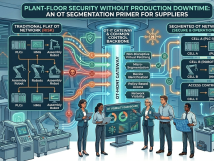
Why Level 1 profiles are the right default, the settings most likely to break HMI and engineering software, and how to document deviations so auditors accept them.
You apply standard Center for Internet Security (CIS) Benchmarks to harden your Windows systems and network switches. Your compliance checklist looks perfect on paper. Then, your human-machine interfaces (HMIs) stop communicating, your SCADA connections drop, and your production line grinds to a halt.
Applying generic IT security baselines to operational technology (OT) networks triggers operational disaster. Manufacturers must safely adapt CIS Benchmarks for manufacturers without breaking legacy industrial software.
The Core Conflict: IT Rigor vs. OT Reality
IT frameworks assume systems receive regular patches, use modern encryption, and tolerate quick reboots. The shop floor operates under different rules where uptime dominates.
Many critical manufacturing applications running on Windows terminals were built over a decade ago. This legacy software relies on insecure defaults—like SMBv1, local administrator privileges, or unencrypted data transfers. Blindly enforcing standard IT baselines blocks these mechanisms, proving that a secure system that stops production is an operational failure.
Three Hardening Mistakes That Halt Production
Teams often break their own industrial software during rollouts by treating hardening as an all-or-nothing IT mandate. This friction stems from three specific mistakes:
- Enforcing Strict Protocol Disables: Disabling old protocols like NetBIOS, LLMNR, or early SMB severs the communication lifeline between legacy network switches, aging HMIs, and your programmable logic controllers (PLCs).
- Restricting Local User Rights: IT profiles tightly limit local access permissions. However, older industrial applications need permanent access to the local OS file system and registry to log real-time shift metrics.
- Automating Untested Patches: Forcing automated updates alters cryptographic settings or RPC paths. This instantly invalidates custom drivers controlling your physical manufacturing machinery.
The Solution: A Staged Hardening Framework
To protect your plant floor without risking costly downtime, deploy a structured, risk-based approach:
- Isolate Testing in Lab Environments: Build a small staging environment that mirrors your shop floor hardware and software. Test your hardened policies here first to pinpoint exactly which rules trigger application errors.
- Deploy Custom Compensating Controls: If an HMI requires insecure settings to run, keep the setting active but wrap the machine in a strict micro-segmented firewall rule to neutralize external threats.
- Implement a Tiered Policy Rollout: Apply non-intrusive settings first—like password lengths. Monitor stability for two weeks before introducing stricter network or account privileges.
Keep Your Lines Running Securely with Cyber Frontline
At Cyber Frontline, we bridge the gap between IT security baselines and industrial automation. We translate complex CIS Benchmarks for manufacturers into safe blueprints that protect your endpoints and network gear while keeping your legacy software stable and your production lines running.