Cloud MES, SaaS labeling platforms, and IIoT sensors don't break the Purdue Model — they raise the stakes for Level 3.5. How to route every modern IT/OT integration through an industrial DMZ without slowing the business down.
Step into any modern manufacturing facility, and you will hear a common refrain from IT architects: “The Purdue Model is dead.” They argue that industrial internet of things (IIoT) sensors, edge computing, and direct-to-cloud telemetry have collapsed the traditional network hierarchy. They claim that the Purdue Enterprise Reference Architecture (PERA) belongs in an industrial museum.
The Purdue Model isn't dead—your implementation is. When companies experience security breaches after connecting a factory floor to cloud analytics, the architecture did not fail. The failure occurred because the team bypassed fundamental structural boundaries in the name of digital transformation. You can achieve cloud connectivity without introducing catastrophic risk, but only if you properly apply PERA in a cloud-connected plant.
The Core Misconception: Agility vs. Isolation
The push for smart manufacturing requires real-world data pipelines. Predictive maintenance algorithms need data from Level 1 vibration sensors, and enterprise resource planning (ERP) systems demand real-time production counts from Level 3 supervisory systems.
Too often, engineering teams solve this by multi-homing network cards or dropping cellular gateways directly onto the plant floor. This approach bypasses safety layers entirely.
Cloud Data Pipelines Require Architecture, Not Shortcuts
You do not need to give an Azure or AWS cloud endpoint direct access to your programmable logic controllers (PLCs) to harvest data. PERA was never intended to block data flow; it was designed to regulate it. The architecture establishes clear inspection checkpoints between high-consequence operational zones and low-security business environments.
The immutable rule of industrial operations remains simple: Direct internet connections to safety-critical levels equal total vulnerability.
Three Mistakes That Break Modern Purdue Architectures
Facilities routinely compromise their operational technology (OT) networks because they view PERA as a rigid hardware checklist rather than a dynamic traffic control strategy. This failure model surfaces in three distinct ways:
1. Allowing Level 0-2 Assets to Initiate External Connections
A smart sensor sitting on a conveyor line (Level 1) should never possess a default gateway that routes directly to the internet. When engineers allow lower-level control assets to establish outbound HTTPS sessions to cloud dashboards, they open an active, unmonitored backchannel through the firewall. Attackers easily hijack these tunnels to drop ransomware directly onto the production line.
2. Eliminating the Layer 3.5 Industrial DMZ (iDMZ)
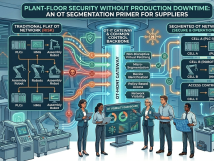
The Industrial DMZ (Layer 3.5) acts as the ultimate airlock between corporate IT and manufacturing OT. Yet, many organizations eliminate this layer entirely to reduce network latency or configuration complexity. Without an iDMZ to terminate sessions, a compromise on a corporate employee's laptop can pivot straight into your SCADA system within seconds.
3. Relying on Single-NIC Database Multi-Homing
To feed data to corporate data lakes, some facilities install dual-network interface cards (NICs) into a single historian server. One card plugs into the OT network; the other plugs into the IT network. This dual-homed configuration creates an unmonitored physical bridge around all firewall controls. It turns your database server into an immediate target for lateral network traversal.
The Solution: Modernizing PERA for the Cloud Era
You do not need to abandon the Purdue Model to benefit from cloud analytics. Instead, update your implementation by enforcing strict data unidirectional models and brokered collection layers.
Deploy Unidirectional Data Gateways and Proxies
Enforce a strict push-only architecture for cloud telemetry. Lower-level assets must write data to a local collector at Level 3. A dedicated proxy server inside the Layer 3.5 iDMZ should then pull that data and forward it to the cloud. No cloud service should ever initiate an inbound connection down into the control levels.
Implement Store-and-Forward Mechanisms
Protect production against external network disruptions. Your Level 3 data collectors must utilize a store-and-forward mechanism. If the cloud connection drops, your plant floor continues to log data locally without interrupting operations. Once the connection safely re-establishes via the iDMZ, the proxy flushes the queued data upward.
Enforce Micro-Segmentation Within Levels
Do not treat Level 2 or Level 3 as giant, open trusted networks. Segment your plant floor horizontally by production cell or manufacturing line. Even if a threat somehow breaches a cloud-connected asset in one area, horizontal firewalls prevent the malware from traveling sideways to affect other critical production lines.
Secure Your Smart Factory with Cyber Frontline
At Cyber Frontline, we do not believe in choosing between operational efficiency and bulletproof security. We engineer robust, cloud-ready networks that respect the integrity of the Purdue Model. We help you implement PERA in a cloud-connected plant safely—protecting your legacy assets while unlocking the full power of modern industrial analytics.