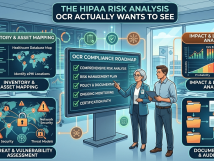
The single most-cited gap in OCR enforcement actions — and a template for doing it right: scope, asset inventory, threat identification, likelihood/impact, and documented risk decisions.
If your manufacturing or logistics firm handles health-related data, employee benefits portals, or medical supply chains, you fall under HIPAA regulations. Yet, many executive teams view healthcare compliance as a basic checking-of-boxes exercise. They throw together a basic security assessment questionnaire and call it a day.
This approach creates a massive liability. The Office for Civil Rights (OCR) actively rejects basic checklists during investigations. If your facility experiences a data breach or an audit, an inadequate documentation strategy triggers severe financial penalties and mandatory corrective action plans.
To defend your organization from massive federal fines, you must deliver exactly The HIPAA Risk Analysis OCR Actually Wants to See.
The Core Standard: True Risk Management vs. Static Checklists
The OCR does not care about generic security templates or empty policy promises. Federal regulators demand a comprehensive, data-driven engineering assessment that tracks every single piece of Protected Health Information (PHI) moving through your facility.
A compliant assessment must evaluate your actual technical architecture. You must prove that your security controls actively identify threats, calculate real-world vulnerabilities, and establish functional mitigation protocols. Regulators evaluate your technical evidence, not your administrative paperwork.
Three Elements That Make Your Assessment Compliant
To satisfy federal investigators, your internal security team must ensure your assessment includes these three mandatory, structural components:
- Complete PHI Data Inventory: You must map out every location where your system creates, receives, maintains, or transmits PHI. This includes local shop-floor servers, remote cloud backups, and corporate email accounts.
- Granular Threat and Vulnerability Mapping: Do not use broad descriptions. You must document specific technical risks—such as unpatched operating systems or unencrypted mobile terminals—and assign accurate probability scores to each threat.
- Documented Technical Remediation Schedules: An assessment means nothing without an active fix. Your report must include an engineered timeline that details exactly how and when your team will patch identified security holes.
Your Practical Framework to Meet OCR Expectations
You can build a defensible, audit-ready security profile by executing this three-step roadmap before federal regulators initiate an investigation:
- Execute a Rigorous Asset Discovery: Run network scanning tools to discover every asset interacting with healthcare data boundaries. Eliminate unmonitored shadow IT channels.
- Implement Strict Encryption and Access Controls: Lock down your data storage. Ensure your systems automatically encrypt PHI both at rest and during transmission across your network zones.
- Consolidate Your Evidence Pipeline: Gather your server configuration baselines, firewall rule logs, and vulnerability patch reports into one centralized folder to present a clean, continuous trail to arriving inspectors.
Pass Your Audits with Cyber Frontline
At Cyber Frontline, we eliminate the guesswork from high-stakes healthcare data security. We help your business engineer and document The HIPAA Risk Analysis OCR Actually Wants to See. We deploy practitioner-led security strategies that satisfy federal regulators, protect your technical infrastructure, and secure your contracts without interrupting your daily manufacturing output.