How to read your customer's requirement letter, what changes between levels (plausibility check vs. on-site assessment), and how prototype protection scope can surprise you.
IIf you supply parts to European automotive brands, your partners will eventually demand a formal TISAX label. Many manufacturing executives look at the extensive compliance handbooks and assume they can choose a basic, self-guided security verification.
The Strategic Difference: Document Review vs. On-Site Inspection
TISAX structures its audits around the specific confidentiality risk of your customer's data.
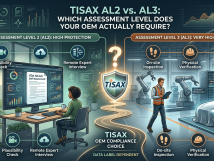
Assessment Level 2 (AL2) functions primarily as a remote verification process. An approved auditor evaluates your written security documentation and interviews your key staff. Assessment Level 3 (AL3) completely eliminates remote assumptions by requiring an independent, multi-day physical inspection of your engineering offices and plant floors. Auditors evaluate your physical execution at Level 3, not just your digital paperwork.
Defining the Two Primary Assessment Levels
To prevent procurement delays and align your engineering teams, you must map your operations against these two audit methods:
- Assessment Level 2 (High Protection): This remote evaluation targets suppliers handling standard proprietary drawings, internal business files, or basic component designs. The auditor checks your security systems via web interviews and digital document samples to confirm you meet the criteria.
- Assessment Level 3 (Very High Protection): This comprehensive audit targets organizations handling highly sensitive data like unreleased prototype designs, autonomous driving source code, or critical industrial control infrastructure. The audit team inspects your physical facility to verify your network isolation, camera placements, and biometric access controls.
Your Practical Roadmap to Secure the Correct Label
You can build a clean, audit-ready compliance profile by executing this three-step framework before you contract an expensive audit provider:
- Verify the Exact OEM Scope Request: Do not guess which level you need. Open your procurement portal or contact your buyer directly to confirm the exact TISAX scope required for your specific vendor number.
- Run a Comprehensive Gap Analysis: Map your current controls against the standard VDA ISA checklist. Identify whether you lack the physical security perimeters and strict asset logging mechanisms required to survive a grueling Level 3 inspection.
Pass Your Automotive Audits with Cyber Frontline
At Cyber Frontline, we take the confusion out of complex international automotive compliance frameworks. We help your manufacturing business evaluate and prepare for TISAX AL2 vs. AL3 audits without risking operational downtime. We deploy practitioner-led security architectures that satisfy strict European registrars, protect your proprietary configurations, and secure your Tier-1 status.